
Signs of AI in Travel Photography: How to Spot Fakes
🔍The short version: Counting fingers stopped working around 2025. The tells that survive in 2026 are physical rather than anatomical: geometry that fails a straightedge, numerals that dissolve when you zoom in, and crowds that quietly repeat. The one most travellers miss is signage in a language they do not read, where a generator produces plausible near-misses that a local spots instantly. When the picture is inconclusive, the file often is not. Check EXIF, GPS and C2PA credentials before you trust your eyes.
The question that used to be easy is not easy anymore. For a few years you could spot a generated image in about two seconds: six fingers, melted ears, a signature smeared into nonsense. That era is over. Current models render hands correctly, and most of the advice still circulating online was written against a generation of image generators that no longer exists.
What follows is how I actually check a travel photograph in 2026, in the order I check it. It starts with the picture and ends with the file, because the file is usually where the argument gets settled.
Why the old advice stopped working
Anatomy was never a fundamental weakness. It was a symptom of models that had not yet seen enough hands. Once they did, the tell disappeared, and every listicle built on it became actively misleading. Worse, that advice creates false confidence: you check the hands, the hands are fine, and you conclude the image is real.
The tells that persist are the ones tied to things a generator does not actually model. A camera records a physical scene through a lens under real light. A generator produces a plausible arrangement of pixels. Most of the time those two things look identical. The gap shows up where the physical world is strict and plausibility is not: in how light propagates, in how straight lines converge, in how symbols carry meaning, and in how a crowd of individuals fails to repeat.
Six signs of AI that still hold up in 2026
The three generated images below were made specifically for this article, and they are labelled as such in every caption. I am not describing failures in the abstract. You can check each claim against the picture directly underneath it.
1. Light that has no source
Real light comes from somewhere, and everything in the frame agrees about where. Shadows fall along consistent angles. Highlights sit on the surfaces facing the source. Contrast drops with distance because there is air in between.
Generated scenes sometimes carry light that is beautiful and incoherent: a building lit warmly from the left with shadows pooling to the left as well, or a blue-hour sky above a street lit like noon. Pick the brightest object in the frame, decide where the light must be, then walk around the frame and check whether everything else agrees.
Be aware that this test has weakened. Current models are good at light, and not one of the three generated images on this page gives itself away through lighting. Every one of them is caught by something else. Treat coherent light as necessary rather than sufficient. It rules images in, it does not rule them out.
2. Geometry and pattern that do not hold up
Architecture is the hardest thing for a generator to fake, because buildings are assembled from repeated straight elements and human eyes are extremely well calibrated to them. Hold a straight edge against a railing, a roofline, a row of windows, a flight of steps.
What you are looking for is not a bend. It is a line that starts as one thing and finishes as another: a balustrade whose posts change profile partway along, a staircase whose treads change depth halfway down, a wall that terminates in mid-air. Real perspective converges toward vanishing points. Generated perspective converges toward roughly the right look.
The same logic extends to pattern, and pattern is the easier half to check, because it needs no straightedge and no eye for perspective. Tilework, carpets, brickwork and tiled facades are all laid down from a rule: one motif, repeated on a fixed grid. Distance shrinks that motif toward the far end of a wall. It never redraws it.
So pick one flat surface, start at the near end, and walk your eye to the far end. You are not asking whether the pattern gets smaller, because it should. You are asking whether it is still the same pattern when it gets there.
 📍 Photo spot: Sultan's Pavilion →
![[AI-GENERATED] Synthetic image of a tiled Ottoman palace interior, produced for comparison and not a photograph](https://cdn.sanity.io/images/q530lc6g/production/2d4484cd4eb154f24759f2db62d0128dc68c56fb-1376x768.jpg)
3. Numerals, clock faces and dials
Text is where meaning and shape have to agree, which makes it the most reliable single test available. A generator reproduces letterforms convincingly and the meaning almost never survives.
Zoom to full resolution on any clock face, street plate, menu board or bus destination. Real text stays text under magnification, even when motion blur or depth of field softens it. Generated text degrades into confident nonsense: characters from the wrong alphabet, a number sequence that skips, kerning that collapses mid-word.
 📍 Photo spot: The Astronomy Clock →
![[AI-GENERATED] Synthetic image of an ornate astronomical clock, produced for comparison and not a photograph](https://cdn.sanity.io/images/q530lc6g/production/f95a9aaad9074a4a421f864c3efc43bc54cc4a8c-1408x768.jpg)
Clock faces are the best stress test you have. They combine numerals, radial symmetry and fixed convention, so a generator has three separate ways to give itself away inside one small area of the frame.
4. Signage in a language you do not read
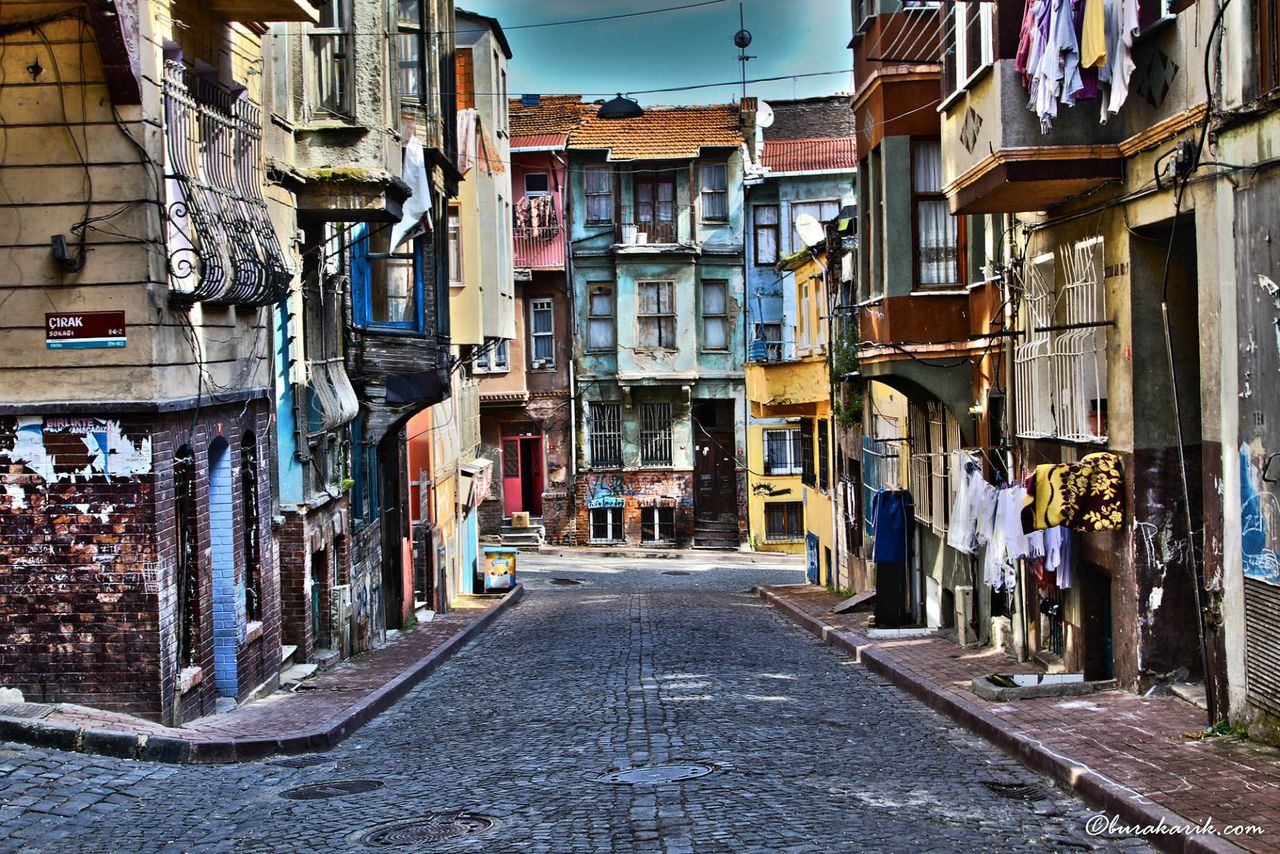
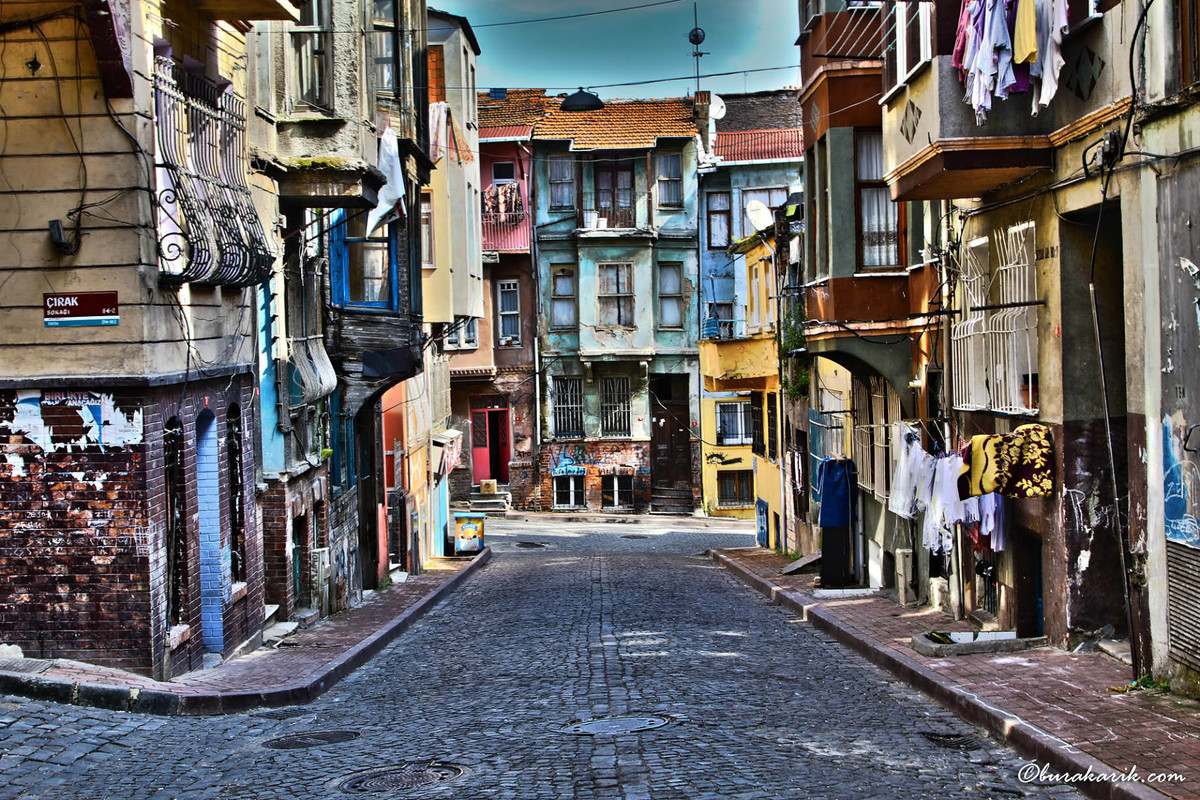
This is the trap specific to travel photography, and I have not seen it covered anywhere. When the sign is in English you catch the error instantly. When it is in Turkish, Greek, Thai or Czech, your eye accepts it, because you were never reading it for meaning in the first place.
Generators do not fail uniformly here. They produce a mixture: some words perfectly correct, others altered by a letter or two into something that looks entirely plausible and means nothing. A traveller skims past it. A local sees it immediately.
 📍 Photo spot: Colorful Balat →
![[AI-GENERATED] Synthetic image of a colourful sloping street with pedestrians, produced for comparison and not a photograph](https://cdn.sanity.io/images/q530lc6g/production/087c62fd3e93a19ebe7fd165627cabd6c5419d0d-1408x768.jpg)
The practical rule: if a photograph claims a place whose language you do not read, paste the visible signage into a translator before you accept it. Real signage translates to something. Generated signage frequently translates to nothing at all.
5. Repetition in crowds and textures
People in a real street scene are individuals who happen to be near each other. People in a generated street scene are variations on a theme. Look for the same face at two different scales, three people with identical posture, a jacket pattern that recurs across the frame, or a crowd where nobody is doing anything awkward.
The same applies to surfaces. Real cobblestones, roof tiles, brickwork and foliage are irregular at every scale; damage, wear and dirt accumulate unevenly. Generated texture tends toward a tidy statistical average, and it often tiles subtly across a large flat area.
6. Reflections and water that disagree with the scene
Reflections are a physical consequence of the scene, so they are a second, independent record of it. Generators treat them as another texture to paint.
Check that a reflection contains the things that should be in it and nothing that should not. Window glass that reflects a building which is not on that side of the street. Wet pavement carrying highlights that have no corresponding light. Still water reflecting a slightly different skyline from the one above it. Rippled water is easier to fake convincingly than still water, so still water is the better test.
What the file itself tells you
If the picture is inconclusive, stop looking at the picture. Almost every claim about an image can be checked against the file that carries it, and this is the part most detection guides skip entirely.
EXIF: the boring evidence that matters most
A photograph out of a camera carries an EXIF block: camera body, lens, aperture, shutter speed, ISO, focal length, and the moment the shutter opened. It is written by firmware at capture time and it is internally consistent in ways that are tedious to forge. A 400mm frame with a wide field of view is a contradiction. An exposure of f/16 at 1/2000 second at ISO 100 in what is clearly deep shade is a contradiction.
Every photograph on this site carries its original EXIF, and the technical panel under each image reads it straight out of the file rather than from anything I typed in. That is not a feature I built to make a point about AI; it is simply what a real capture leaves behind.
The critical caveat: missing EXIF is not evidence of anything. Instagram, WhatsApp, X and Facebook all strip metadata on upload, so most images you encounter in the wild have none. Absence proves nothing. Presence, and internal consistency, is what carries weight.
GPS and the coordinate check
When GPS survives, it is checkable in a way almost nothing else is. Drop the coordinates into a map, switch to satellite or street view, and confirm that the terrain matches: the direction the camera faced, the position of the coastline, whether that ridge is really behind that building. A generated image has no coordinates to check. A misattributed real image very often has coordinates that quietly contradict the caption.
Content Credentials and SynthID
Two provenance systems are now worth knowing. C2PA Content Credentials attach a signed manifest describing how an image was made and edited, and are supported by a growing set of cameras and editing tools. SynthID embeds an imperceptible watermark into images generated by Google's models, detectable even after moderate cropping or compression.
Both are genuinely useful and neither is a general answer. Credentials are stripped by the same platforms that strip EXIF, and a watermark only tells you about the specific model family that wrote it. A positive result is strong evidence. A negative result is not evidence of anything.
Do AI image detectors actually work?
Partially, and less well than their marketing suggests. Every automated detector is a probability estimate, and each fails in a different, predictable way.
| Method | What it actually checks | Where it fails |
|---|---|---|
| Google "About this image" | SynthID watermark plus the image's history across the web | Only sees Google's own model family; silent on everything else |
| C2PA credential readers | A signed manifest describing capture and edit history | Manifest is stripped by most social platforms on upload |
| Statistical classifiers (Sightengine, Hive) | Pixel-level artefacts learned from generated training data | Confidence collapses on cropped, re-compressed or edited images |
| Reverse image search | Whether this scene existed before the image was posted | Proves an original exists; cannot prove this file is it |
Treat a detector as one input. If a classifier says ninety percent synthetic and the numerals on the shop sign are unreadable and there is no EXIF, you have a case. If a classifier says ninety percent synthetic and everything else checks out, you probably have a heavily edited real photograph, which is what classifiers most often mistake for generated output.
A 60-second checklist
In the order that resolves the most cases fastest:
- Zoom to full resolution on any text in the frame and read it. Signage, clock faces, number plates.
- If the signage is in a language you do not read, paste it into a translator. Real signage means something.
- Pick the light source, then check that every shadow in the frame agrees with it. Passing this proves less than it used to.
- Run a straight edge along a railing, roofline or staircase and count the repeated elements.
- Scan any crowd for a repeated face, a repeated posture, or nobody doing anything awkward.
- Check reflections in glass and still water against what is actually in the scene.
- Open the file's EXIF. Look for internal consistency, not merely presence.
- If GPS survives, put the coordinates on a satellite map and confirm the terrain.
- Run one detector, and treat the result as a vote rather than a verdict.
What this means if you make pictures
The practical consequence is that provenance is becoming part of the work. Keeping originals with metadata intact, publishing where that metadata survives, and being able to show the frames either side of the one you published are all becoming ordinary parts of being believed.
I have written separately about what this shift means for the profession, and whether travel photographers are still needed at all, in The Future of AI Travel Photography. This piece is the practical companion to that one.
Frequently Asked Questions
Is it AI generated? What is the fastest way to check?
What are the clearest signs of AI in travel photography?
How can I check a photo of a place whose language I cannot read?
Can you still tell AI from real travel photography?
Does missing EXIF data mean a photo is AI generated?
Do AI image detection tools work for travel photos?
Are AI generated images of real places always fake locations?
Sources and further reading: C2PA Content Credentials specification, Google DeepMind on SynthID, and the GIJN Reporter's Guide to Detecting AI-Generated Content.
Keep exploring
Travel Guides
Day-by-day photographic guides with maps, gear notes, and the photos shot along the way.
Photo Galleries
1,300+ travel photos from 43 countries, organized by destination with EXIF and GPS.
About the Photographer
Years behind the lens, gear philosophy, and the story behind the portfolio.
Get in Touch
Questions about prints, licensing, or a shoot? Reach out and start a conversation.