
Japan Sakura Photography Itinerary: Tokyo, Kyoto and Mt. Fuji
The first real frame of the trip came at 5:45 in the morning at Sensō-ji, camera bag still stiff from the eleven-hour flight. I'd left the family asleep at the Shinjuku apartment and walked out into a Tokyo that was only half awake, Yamanote-line doors hissing at empty platforms, and I remember thinking that the whole 13-day plan was going to live or die on how I handled the gap between jet lag and golden hour. This guide is what I learned, in order.
The shape of the trip was Tokyo for four nights, then Kyoto for five with Nara and Osaka as day trips, then back to Tokyo for three more nights with a DisneySea day baked in. Sakura was the calendar anchor: Tokyo was already past peak when we landed, Kyoto hit full bloom the week we arrived, and Lake Kawaguchiko and Chureito were about a full week early. I had assumed sakura arrives across Japan more or less simultaneously. It does not, and I learned that the hard way. That stagger is actually useful if you plan around it: you can chase the bloom wave rather than gambling everything on a single window.
I shot almost everything on the FUJIFILM X-T5 with the XF16-80mm f/4, and that is basically the whole kit recommendation. The 10-24mm came out at Fushimi Inari and once inside Higashi Hongan-ji, and otherwise stayed in the bag. If you pack one body and one lens for Japan in sakura season, the 16-80 is the lens. It covers the temple-and-pagoda compression stacks, the street-level scramble scenes, the tight kazaridaru detail, and the blue-hour cityscapes without a swap. Packing light is extremely important: at 30,000 steps a day, every extra gram of weight compounds hard toward the second half of the day.
Light in Japan at this latitude in late March moves fast. Sunrise slides from 05:36 in Tokyo to 05:43 by the time you're in Kyoto a week later, and the golden-hour window at both ends of the day is short and cool. Plan on being in position before the hour, not during it. Every best frame I made on this trip was shot before the coffee shops opened or after the last temple bell; the middle of the day is for walking, scouting, and eating.
One place where waiting simply did not work: Chureito Pagoda. Even racing to the front row, other visitors' hands and clothes crept into the frame constantly, and I spent close to half an hour jostling for the best position. Fushimi Inari was more manageable once I stopped lingering at the lower gates and pushed up the mountain, where the crowds thinned considerably. The Arashiyama bamboo grove rewarded patience differently: spending the day in the park and walking back through the grove in the early evening meant only a handful of people, though the fading light demanded high ISO and steady nerves.
Japan Sakura Photography Itinerary at a Glance
This route worked best as a photography-first loop: Tokyo for the first city frames, Mt. Fuji as an early private day trip, Kyoto for peak sakura, then Nara and Osaka as compact side trips before returning to Tokyo. If I were planning it again, I would keep the same overall structure but stay one night in Osaka and add one more dawn session in Kyoto.
For photographers, the real lesson is not only where to go, but when to be there. Tokyo, Kyoto and Fujiyoshida do not peak at the same time. On this trip, Tokyo was already past peak, Kyoto was at full bloom, and Chureito Pagoda near Mt. Fuji was still early. That stagger can either hurt the trip or help it, depending on how flexible the plan is.
Quick version of the route:
- Best route: Tokyo → Mt. Fuji → Kyoto → Nara → Osaka → Tokyo
- Ideal length: 11 to 13 days
- Best base cities: Tokyo and Kyoto
- Best single lens: FUJIFILM XF16-80mm f/4, or a 24-120mm equivalent on full frame
- Best extra lens: a 70-200mm or 70-300mm equivalent for compression at Chureito Pagoda and Fushimi Inari
- Best shooting rhythm: sunrise and blue hour for serious frames, midday for transit, scouting, meals and family time
Best Photo Stops in This Japan Sakura Route
These are the places I would prioritize if I had to compress the trip into the strongest photography moments.
- Sensō-ji at dawn, Tokyo: Best for quiet temple atmosphere before the Nakamise crowds arrive. The gate, lantern and early visitors give the frame structure before the day becomes too busy.
- Lake Kawaguchiko, Mt. Fuji: Best for the clean Fuji landscape frame. Early morning matters because the water is calmer and the mountain is more likely to stay visible.
- Chureito Pagoda, Fujiyoshida: Best for the classic pagoda, Fuji and sakura composition, but only if the bloom timing lines up. Go very early and expect a crowded terrace.
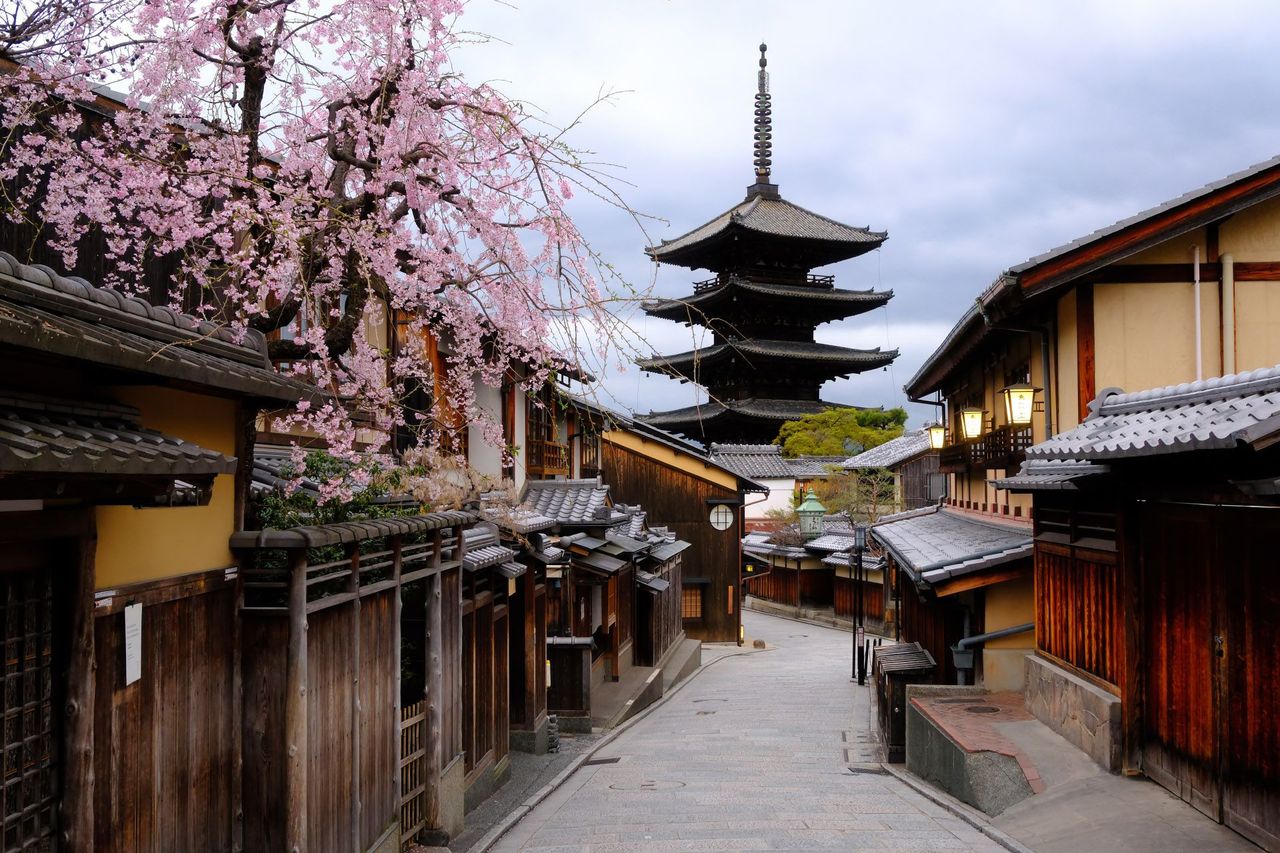
- Yasaka Pagoda and Ninenzaka, Kyoto: Best for old Kyoto street layers, especially before 6:30 AM. The empty-street window is short, but the reward is worth the alarm.
- Fushimi Inari, Kyoto: Best for repetition, rhythm and torii-gate compression. Push higher up the mountain instead of staying only at the lower gates.
- Arashiyama Bamboo Grove, Kyoto: Best in the late afternoon or early evening, when the crowd thins and the light turns directional.
- Philosopher's Path, Kyoto: Best during full bloom, especially if you avoid the obvious center-path composition and look for bridges, water and side shrines.
- Osaka Castle and Dotonbori, Osaka: Best as a contrast to Kyoto. The castle works in daylight with sakura and water reflections, while Dotonbori belongs to blue hour and neon.
| Gear | Frames on this trip |
|---|---|
| FUJIFILM X-T5 | 33 |
| XF16-80mm f/4 R OIS WR | 29 |
| XF10-24mm f/4 R OIS | 4 |
Day 1: Sensō-ji at Dawn — Shibuya Sky and teamLab by Nightfall
8 stops
| Distance walked | 10.9 km |
| Photos kept | 4 |
| Sunrise / Sunset | 05:36 / 17:58 |
| Golden hour | 17:24 onward |
| Locations | Sensō-ji, Shibuya, Shibuya Sky, Harajuku, teamLab Planets |
I left the apartment at 5:45 from Home N Lounge, where we were staying and had booked through Booking.com, and caught an almost-empty Ginza line east. Sensō-ji at first light is a completely different temple from the one in the guidebooks; the Nakamise shutters are still down, a few priests cross the forecourt, and the Kaminari-mon lantern hangs over nothing but cold air. By 8:30 the first tour groups had filtered in, and that's when I spotted the couple under the lantern. I walked over and asked permission before raising the camera; they said yes immediately. A wedding, an anniversary, or simply locals observing the old custom of visiting Sensō-ji in kimono, I never found out.
 📍 Photo spot: A Couple at Sensō-ji →
I shot them at 27mm on the 16-80, f/4, ISO 125, and the lens choice mattered: wide enough to keep the Kaminari-mon lantern in frame as anchor, long enough to compress the crowd behind them into soft context. Whether it was a wedding or a paid kimono session I don't know, but the bride's white bouquet against the red lantern did all the color work for me. If you're shooting Sensō-ji for portraits, the gate is the frame; everything else is noise.
By 10:30 we were on a Yamanote train south to Shibuya. The sakura in Tokyo had peaked a week before we landed, which shifted the day's photographic weight onto the cityscape rather than the parks. Shibuya at noon is the opposite problem from Sensō-ji at dawn: there is too much, everywhere, and the craft is subtraction. I worked handheld at 30mm, f/7.1, letting the signage stack into layers behind the crowd.
 📍 Photo spot: Vibrant Shibuya Streets →
After an hour on the streets we went up to Shibuya Sky, which is genuinely one of the best vantage points for a Shibuya Crossing shot in the city. Book tickets through Klook well ahead — sunset and blue-hour slots sell out first and fastest; aim for at least a month out if blue hour is your target. We missed that window. From the upper indoor level, the Crossing is already a visually overwhelming frame: signage, crowds, geometry, motion. So I made one deliberate subtraction and shot it in black and white at 76mm, pulling color out entirely to let the structure breathe. The wider skyline came at 54mm, both near f/7.1 for corner-to-corner sharpness.


The Scramble from above is a hypnotic frame you already know — the value of shooting it yourself is in the waiting, watching one cycle, guessing the next, pressing the shutter on the second or third pulse instead of the first. Tokyo Tower in the wider skyline sits roughly center-left from Shibuya Sky's east windows, and on a clear day Mt. Fuji ghosts in faintly to the west; we could just make it out. Both frames came out of the same ten-minute window.
The Scramble from above is less a photograph than a rhythm: one cycle to learn, the next to shoot, the third to stop and just watch.
From Shibuya we walked up to Harajuku through Cat Street, ate, and took the metro out to Toyosu for teamLab Planets in the evening. Book through teamLab's official website ahead of time; the 12-year-old needed their student ID for the junior ticket, and bare feet with rolled pant legs are mandatory inside. But here is the honest note: I went to teamLab to be present with my family, not to shoot. Sometimes you need to know when to put the camera away and just enjoy the moment. By the time we stepped back outside, we were so exhausted we could barely get ourselves into a taxi. The Tokyo Metropolitan Government Building observation deck had been my plan for a Shinjuku capstone, but the day had other ideas.
Day 2: Chureito Pagoda and Mount Fuji — Oshino, Kawaguchiko, Evening Shinjuku
8 stops
| Distance covered | 101 km (private van) |
| Photos kept | 6 |
| Sunrise / Sunset | 05:39 / 18:03 |
| Notable locations | Chureito Pagoda, Oshino Hakkai, Lake Kawaguchiko, Shinjuku Gyoen, Omoide Yokocho |
We booked a private van day for Fuji with an English-speaking guide, 6 AM pickup from Shinjuku, door-to-door return by late afternoon. This is the single logistics call I would make again without hesitation. The train version of this day — Shinjuku to Otsuki to Kawaguchiko, then local bus loops — works but you'll lose two hours of shooting light to transfers. For photography-driven Fuji, the van buys you the morning.
First stop was Lake Kawaguchiko. We hit the north shore early, before the wind picked up, and Fuji was clean on the horizon with a band of reeds and early-season flowers in the foreground.
 📍 Photo spot: Morning at Lake Kawaguchiko →
Shot at 21mm, f/7.1, ISO 125. The frame is a classic three-layer composition — foreground reeds and flowers, mid-ground lake, Fuji in the back — and the only real decision is how much sky to let in. I went half-and-half. If you can only make one Fuji stop, this is the one; the east shore of Kawaguchiko at sunrise or early morning is the most photographable Fuji view I've ever stood in front of.
From Kawaguchiko the van took us up to Chureito Pagoda at Arakurayama Sengen Park in Fujiyoshida — 398 stone steps, about 15 minutes with gear. This is one of my most regretful moments from the trip. I arrived assuming sakura season meant all of Japan blooms together, the way it looks in every travel photo. What I learned the hard way: it moves in sequence, Tokyo first, then Kyoto, then Fujiyoshida, roughly a week apart each. The trees here were completely bare. One week later and that pagoda-Fuji-sakura triangle would have been mine.
 📍 Photo spot: Chureito Pagoda and Mount Fuji →
What I wasn't prepared for was the crowd. Even with bare trees, the terrace was packed with at least a hundred photographers, all jostling for the same front-row position in front of the pagoda. It felt less like a viewpoint and more like a competition. You have to be opportunistic: watch for gaps, move fast, and hold your ground. That's actually why I'd recommend making Chureito your first stop of the day rather than Kawaguchiko. The lake is busy too, but the terrace here is legendary for a reason, and the window for a clean shot is narrow.
Midday we pivoted to Oshino Hakkai, the spring-fed village east of the lakes. By the time we arrived Fuji was hiding behind a cloud band and the village paths were shoulder-to-shoulder with tour groups, so I bagged the camera and walked. If you can get there at opening, the ponds and thatched roofs pair beautifully with a clear Fuji background; by 12:30 it's a different experience.
The last Fuji frame of the day came from Honcho Street in Fujiyoshida, already well-known in photographer circles as the spot where the mountain rises cleanly between the shopfronts and power lines. It earns that reputation. The alignment of the peak with the street corridor is almost too good to be true, and the streetlamps and wiring that might read as clutter in another composition become the whole point here, anchoring Fuji in the texture of a working town rather than floating it above a pristine lake.
 📍 Photo spot: Mount Fuji from Fujiyoshida →
56mm, f/6.4, ISO 125. This frame is the argument for Fujiyoshida over Kawaguchiko if you already have the lake shot: the mountain-through-the-town view is cinematic in a way the pure-nature frames are not, and the power lines are a feature, not a bug. The guide pulled the van over for three minutes and this was the take. Having a driver who understood 'thirty more seconds' instead of 'we're stopping for thirty minutes' was quietly the difference between a good Fuji day and a great one.
The street is completely ordinary — and that's exactly the point. The mighty, infamous mountain behind it is what makes the ordinary extraordinary, and I'd have stayed an hour longer hunting the perfect traditional shopfront to frame it against.
Back in Tokyo by late afternoon, I walked to Shinjuku Gyoen to catch the cherry blossoms at the end of their peak — Tokyo was roughly a week past central bloom but Gyoen's later varieties were still holding. Shot at 44mm, f/6.4, ISO 125, with a plane crossing the sky behind the branches, which I noticed only in the edit. Gyoen's mix of traditional Japanese and Western garden layouts makes it the most photographable cherry-blossom park in central Tokyo; the view-plane of blossoms against the skyline is unique to this park.


From Gyoen I walked west into Shinjuku as blue hour dropped, and finished the day in Omoide Yokocho, the Memory Lane alleys just west of the station. 21mm, f/5.6, ISO 1250, 1/30s handheld — the whole alley is maybe camera-body wide, so the 16-80 at its widest is actually the right tool. The alley is lit almost entirely by overhead signs and yakitori grills; meter for the highlights, let the shadows go. For a first-night Shinjuku walk this is the unbeatable closer.
Day 3: Meiji Jingu's Forest — Sake Barrels and Tokyo Tower at Dusk
7 stops
| Distance walked | 5.5 km |
| Photos kept | 4 |
| Sunrise / Sunset | 05:34 / 18:00 |
| Locations | Meiji Jingu, Harajuku, Nakano Broadway, Shinjuku west side |
I wrote this day into the itinerary as a deliberate breath between the Sensō-ji stack and the 5 AM Fushimi Inari sortie coming up in Kyoto. Sleep in, 9:30 departure, and walk rather than train where possible. If you're building your own 13-day plan, schedule one of these every three to four days. The alternative is a cumulative fatigue that shows up in your frames by day eight.
First light on the walk toward Harajuku crossed a rail overpass where the Yamanote and a parallel line ran side by side, and I grabbed a quick frame of the trains layered against the Shibuya skyline. I wasn't looking for it, had no pin on a map, no reference saved. I found out afterward that it's a well-known spot in the photography community, which made the coincidence feel almost absurd. Tokyo has thousands of streets. That's the argument for walking slowly and staying curious over sleeping in.
 📍 Photo spot: Tokyo Street View →
From there I went to the Kitasandō torii at Meiji Jingu's south approach. The main torii at the Harajuku-side entrance is the photographed one, but Kitasandō is quieter and the forest canopy closes over the path in a way that reads beautifully in filtered late-morning light. 18mm, f/6.4, ISO 640. The wood is still the original Kiso cypress the shrine is famous for, and the gate frames the gravel path in a way that basically composes itself — stand on the centerline and wait for a gap between visitors.
 📍 Photo spot: Torii Gate at Meiji Shrine →
A few hundred meters further in, the shrine precinct opens onto the kazaridaru wall, and the first thing that struck me was how purely visual it is — no residual sake smell, no lacquer, nothing. Just pattern. I deliberately adjusted the frame until nothing but barrels filled the viewfinder, edge to edge, so the repetition of labels and Japanese lettering could do all the work. 74mm, f/4, ISO 500 — tight enough to isolate the graphic detail of each brewery's design while keeping the stacked rhythm intact. It is a textbook pattern-photography subject, and the wall almost frames itself.
 📍 Photo spot: Sake Barrels at Shibuya Shrine →
Meiji's kazaridaru wall is one of the most densely photogenic surfaces in Tokyo. Every barrel is a different graphic artifact.
The afternoon went to Nakano Broadway, the retro manga-and-collectibles arcade a short metro ride west of Shinjuku, and then a deliberate sunset loop that ended in Minato near Tokyo Tower. The frame came together on Sakurada-dori Avenue, mid-crosswalk, at a red light. I was already across when I spotted the Lamborghini parked with the tower rising directly behind it, so I stopped at the center point, grabbed the camera, and took the shot. A couple of seconds later the light changed and traffic resumed. No second chance, no repositioning.
 📍 Photo spot: Tokyo Tower and Lamborghini →
30mm, f/7.1, ISO 160, handheld. The red-and-white of the tower answers the saturated hood color in a way that doesn't feel forced, and the Fast and Furious reference writes itself. For Tokyo Tower generally, I'd recommend one of three perches: the Zojoji Temple forecourt for the classic temple-and-tower frame at blue hour, Roppongi Hills' observation deck looking down the axis, or a random Minato side street for the unplanned frames the other two spots won't give you. The exact GPS pin is on the photo page if you want to walk to the same corner.
We closed the night on foot through Golden Gai and back into Omoide Yokocho. High ISO, fast prime if you have one; I was still on the 16-80 f/4 and pushed ISO 1250-1600 without hesitation. The X-T5 files hold up. Alleys here are barely wider than the camera body, so plan to shoot mostly straight ahead and not sideways.
Day 4: Shinkansen West to Kyoto — Yasaka Pagoda at Dusk
7 stops
| Distance walked | 0.6 km (transit-heavy day) |
| Photos kept | 3 |
| Sunrise / Sunset | 05:48 / 18:16 |
| Locations | Tokyo Station, Wajimaya Ryokan, Yasaka Pagoda, Pontocho |
Morning was the transfer west. Nozomi 253 out of Tokyo Station at 10:21, Car 14 Row 1 (front of the car, cleanest window work), arriving Kyoto at 12:32. We booked through Smart-EX, which is the official online portal for shinkansen reservations and works end-to-end in English. The Mt. Fuji pass comes around 45 minutes in on the right-hand side near Shin-Fuji station; have the camera in your lap from the 40-minute mark. It's a two-minute window and the train is moving at 270 km/h.
Bags at Wajimaya Ryokan by 12:45, official check-in at 15:00, which is a standard ryokan pattern in Kyoto — drop and roam. Wajimaya enforces an 11 PM curfew, no in-and-out after, and I mention this now because it shaped our Osaka day later in the week. Plan evenings accordingly. The ryokan itself is a ten-minute walk from Kyoto Station; the neighborhood is quiet, the building is old wood, and the bath rotation is a small ritual at the end of the shooting day.
Late afternoon I went straight to Higashiyama while the side light was still warm. The Yasaka Pagoda rises out of the Ninenzaka and Sannenzaka lanes and is one of those subjects where the approach matters more than the destination — you want to walk up toward it, not around it.


The busy-afternoon frame at 46mm and the slightly-tighter Gion-side frame at 56mm are roughly fifteen minutes apart on foot. Both are shot into the late side light around 4 PM, which rakes across the machiya roofs and sidelights kimono silk beautifully. The streets are lousy with tourists in rental kimono, which actually helps the pictures if you lean into them as subject rather than fight them as obstacle. Wait for a gap in the hats and walk on.
The tourists in rental kimono aren't obstacles — they're the subject. Lean into them, wait for the gap, walk on.
I wandered up to Kōdai-ji as the cloud cover thickened; the sakura there were in their moody, overcast best, the kind of diffused light that makes the pink go saturated instead of blown-out. I ended the evening in Pontocho, the lantern alley on the west bank of the Kamogawa, which is where Kyoto evenings properly end. Dinner, a slow walk back, and in by curfew.
Day 5: Fushimi Inari Before Sunrise — Bamboo Grove by Nightfall
8 stops
| Distance walked | 11.1 km |
| Photos kept | 6 |
| Sunrise / Sunset | 05:47 / 18:17 |
| Locations | Fushimi Inari, Arashiyama Bamboo Grove, Monkey Park Iwatayama, Togetsukyō Bridge |
5 AM alarm, 5:00 departure, solo. Fushimi Inari was the single highest-priority photographic window of the trip and the only way to shoot it is to beat the crowd. The shrine grounds never close, so you can be on the main torii approach by 5:30, at the Senbon Torii gates before 6, and back down by 7:30 before the first organized tour arrives. I was back at Wajimaya for a late breakfast by 9.
The main Senbon Torii corridor is the money shot, but the upper switchback gates beyond Okusha Hōhaisho are where the real repetition lives. I worked with the XF10-24mm wide-open at f/4 and f/5, pushing ISO to 3200 where needed in the tunnel shadow. For once I'd actually recommend going the other direction — a longer telephoto to stack the gates into deeper compression. 35mm equivalent is too wide to get the pattern to read. I'd bring a 50-85mm next time.
 📍 Photo spot: Fushimi Inari Pathway →
A woman in traditional dress walked through the frame at 13mm, f/8, and the wide focal length does a different job than the telephoto would — it puts her inside the gate architecture rather than compressing the gates around her. Both frames are worth having; neither replaces the other.
 📍 Photo spot: Torii Gates in Kyoto →
The deeper up-the-mountain frame is 24mm at f/11, ISO 3200, 1/25s handheld. f/11 is aggressive for that light level but I wanted the inscriptions on the gate pillars — donor names and donation years — to hold sharpness from front to back. Each gate here is sponsored by an individual or business and the inscriptions are part of the subject. Midway up the mountain there's a tea-house clearing where the kitsune fox statues stand guard with keys in their mouths; I photographed those too but they read better as documentation than as a hero frame.
From Fushimi we regrouped and took a train west to Saga-Arashiyama for the afternoon. The Arashiyama loop — bamboo grove, Togetsukyō bridge, Monkey Park Iwatayama — is a two-kilometer on-foot circuit, easy to do in half a day. The monkey park is a twenty-minute uphill hike and pays off with a Kyoto basin panorama; the bamboo grove and bridge are flat.
I waited until late afternoon for the bamboo grove specifically because the crowds thin after 5 PM and the low sun rakes through the stalks at an angle that ten-in-the-morning light can't touch. 46mm, f/4.5, ISO 3200, 1/15s handheld with OIS doing serious work.
 📍 Photo spot: Cherry Blossoms in Arashiyama →
 📍 Photo spot: Arashiyama Bamboo Walk →
The wider Arashiyama park frame at 19mm holds the cherry blossoms in foreground layers with the bamboo mid-ground; the tighter 46mm frame isolates the vertical rhythm of the stalks. Different pictures, same ten-minute light window. If you can only make one Arashiyama visit, go at 4:30 PM in sakura season, do the bamboo grove first, then walk down to the Togetsukyō bridge for dusk, then back through the park while the streetlights come on.
 📍 Photo spot: Evening Sakura in Arashiyama →
That last frame is the park's illuminated sakura tunnel at 17mm, f/4.5, ISO 1600. The streetlights up-light the blossoms from below and make them glow in a way natural light can't. We caught the last twenty minutes before crowds returned; the whole illumination runs a short window during sakura season and the exact dates shift each year — verify before the trip.
Every serious Kyoto photograph I made on this trip was either before 7 in the morning or after 5 in the afternoon. The middle of the day is for walking.
Day 6: Kinkaku-ji Reflections — Dawn Yasaka and the Philosopher's Path
6 stops
| Distance walked | 9.4 km |
| Photos kept | 3 |
| Sunrise / Sunset | 05:45 / 18:18 |
| Locations | Yasaka Pagoda, Ninenzaka, Kinkaku-ji, Ryōan-ji, Philosopher's Path, Ginkaku-ji, KUOE |
Second early start of the week. I wanted Yasaka Pagoda without the Instagram crowd and that means being in position by 5:50. I walked up from Wajimaya in the dark and found, to my mild embarrassment, that there was already a line of maybe eight photographers on the centerline of the street when I arrived at 5:50. By 6:15 it would be twenty. The lesson is that early is relative — add another thirty minutes to whatever you think is early.


The pagoda frame is 22mm, f/7.1, ISO 1250, 1/30s handheld; the Ninenzaka frame is 18mm, f/8, ISO 640. The cherry blossoms were at proper peak and Kyoto woke up pink. Within ten minutes of shooting the second frame, the street filled in behind me — by 6:30 the empty-Ninenzaka window had closed. If you're here for these two specific photographs, the 20-minute buffer between first light and the crowd arrival is the entire assignment. Everything else on the day is a bonus.
After breakfast back at the ryokan we took a bus up to the Kitayama temples. Kinkaku-ji opens at 9 and the still-pond reflection holds best in the first hour — any wind at all and you lose the mirror. We were there at opening. I'll cover the Kinkaku-ji frames properly in the Nara day section where the photos landed in the edit; for now, if you're scheduling, go Kinkaku-ji first thing, then walk over to Ryōan-ji for the rock garden (15 minutes on foot), then bus south.
Midday we detoured into central Kyoto to visit KUOE, a single-storefront Kyoto watch brand at 224 Eirakucho in the Tohbeh Building on Teramachi. The shop is open 11:00 to 17:30 and closed Tuesdays — worth checking before you reroute. A photographer named Burak walks into a watch shop is a setup for a joke I don't have a punchline for, but I spent twenty minutes talking to the owner about case-finishing and walked out with a small Kyoto-made object I didn't come to Japan planning to buy. These detours, the named-business detours, are what makes the middle-of-the-day hours earn their place.
Afternoon was the Philosopher's Path walked south-to-north, from the Eikan-dō end up to Ginkaku-ji, roughly two kilometers along the canal. Sakura were at full tunnel peak and the crowd was dense. The trick with the Philosopher's Path is not to shoot the obvious tunnel-from-the-middle frame — everyone has that one — but to find the side bridges and the small shrines branching off, where the blossoms arch over water rather than over the path. Ginkaku-ji's moss gardens at closing held soft horizontal light. A frame of a kimono-clad couple on Togetsukyō from earlier in the week sits in this day's edit too.
Day 7: Nara's Deer Park — Kinkaku-ji Details and Kiyomizu Illumination
7 stops
| Distance covered | 76.8 km (with Nara day trip) |
| Photos kept | 5 |
| Sunrise / Sunset | 05:44 / 18:19 |
| Locations | Kinkaku-ji, Nara Park, Tōdai-ji, Kasuga Taisha, Kiyomizu-dera |
This day is a two-part shape: Kinkaku-ji at opening to catch the reflection, then a full Nara trip, then Kyoto's Higashiyama illumination after dark. On paper it's ambitious; in practice the Nara train is 45 minutes each way and the deer park is compact, so the math works.
Kinkaku-ji near opening gives you the calmest pond surface of the day. Wind picks up through the morning, and by 11 the mirror is choppy enough that the reflection softens. We were there at 9:30 — not quite opening, but early enough for a clean reflection frame.


The wider frame is 29mm, f/7.1, the full pavilion-and-pond composition. The tighter detail frame is 80mm wide open — the top two stories of Kinkaku-ji are leafed in gold, and at 80mm the individual phoenix on the roof crown reads. Two frames, two focal lengths, same ten-minute window. If you're bringing a single zoom, a 16-80 or 24-120 equivalent is the right range; anything shorter and you miss the detail, anything longer and you can't fit the wider reflection.
The deer in this frame wasn't bowing at the exact moment I pressed the shutter, but it had bowed to us many times before and after, asking for sembei crackers. That's the part that stings a little: by the time we reached the Kasuga Taisha area, the crackers were all sold out. The deer kept bowing anyway, and we had nothing to give back. A small, genuinely sentimental moment. Arrive earlier in the day if you want to feed them. They're wonderfully accustomed to people, shaped by years of that interaction, but they are still wild animals, and holding both truths at once is exactly what makes the picture worth making at 43mm, f/8, close enough to read the soft fur against the carved stone lantern.


The stone-lantern frame is the Kasuga Taisha approach; hundreds of moss-covered lanterns line the path, and pairing one deer against the carved stone is the picture that separates Nara from any other deer park you've been to. The wider herd frame with the sakura tree came from the open meadow near Tōdai-ji. Tōdai-ji's interior is dark enough that handheld Daibutsu frames come out soft; I stabilized against the main-hall railing and still only kept one. Consider a small travel tripod for temple interiors if you can justify the weight.
Back to Kyoto by late afternoon, and up to Kiyomizu-dera by city bus for the night illumination. Kiyomizu's sakura-season night illumination runs only during peak bloom — verify the dates annually, they're published a few weeks ahead — and features a single blue light beam projected up from the main hall. The flood-lit stage deck over the valley is the frame everyone remembers.
Kiyomizu's blue light beam runs only during sakura peak. Miss the dates by a week and you miss the photograph.
I closed the night at Higashi Hongan-ji, the enormous wooden temple near Kyoto Station, photographed from outside at 19mm, f/5.6, ISO 3200 with a long shutter. The night lighting picks out the architectural detail in a way that day light flattens. Higashi Hongan-ji is one of the largest wooden structures in the world and the after-dark walk-around is underrated.
Day 8: Osaka from Kuromon to Dotonbori — Castle at Peak Bloom
6 stops
| Distance covered | 40.1 km (with Osaka day trip) |
| Photos kept | 3 |
| Sunrise / Sunset | 05:43 / 18:19 |
| Locations | Higashi Hongan-ji, Kuromon Market, Osaka Castle, Dotonbori, Shinsekai |
Morning before the Osaka train I slipped into Higashi Hongan-ji while the temple was still quiet. The interior of the main hall is one of the largest wooden spaces I've stood in, and at 8:30 the morning prayers were just underway.
 📍 Photo spot: Inside Higashi Hongan-ji →
12.6mm on the XF10-24, f/5, ISO 2500, 1/18s handheld braced against a pillar. Photography is permitted inside the main hall but flash is not, and you should compose your frame before you raise the camera — the hall is a working place of worship and not a studio. Worshippers seated in the foreground give the frame scale; the lantern and gold detailing do the rest. The 10-24mm came out here specifically because the hall is too wide and too low-lit for the 16-80 to cover comfortably.
Train to Osaka, roughly 30 minutes from Kyoto on the rapid service. Osaka at peak sakura is a different tonal register from Kyoto — brasher, neon-er, and the castle grounds are mobbed. We hit Kuromon Ichiba Market first for an early lunch, then made for the castle. The moat reflection shot at 34mm, f/8, ISO 125 was made with a circular polarizer dialed for maximum color contrast — a filter I run on every daylight shoot. That blue sky isn't luck; it's the polarizer cutting haze and deepening the saturation until the castle silhouette really separates from the water beneath it.
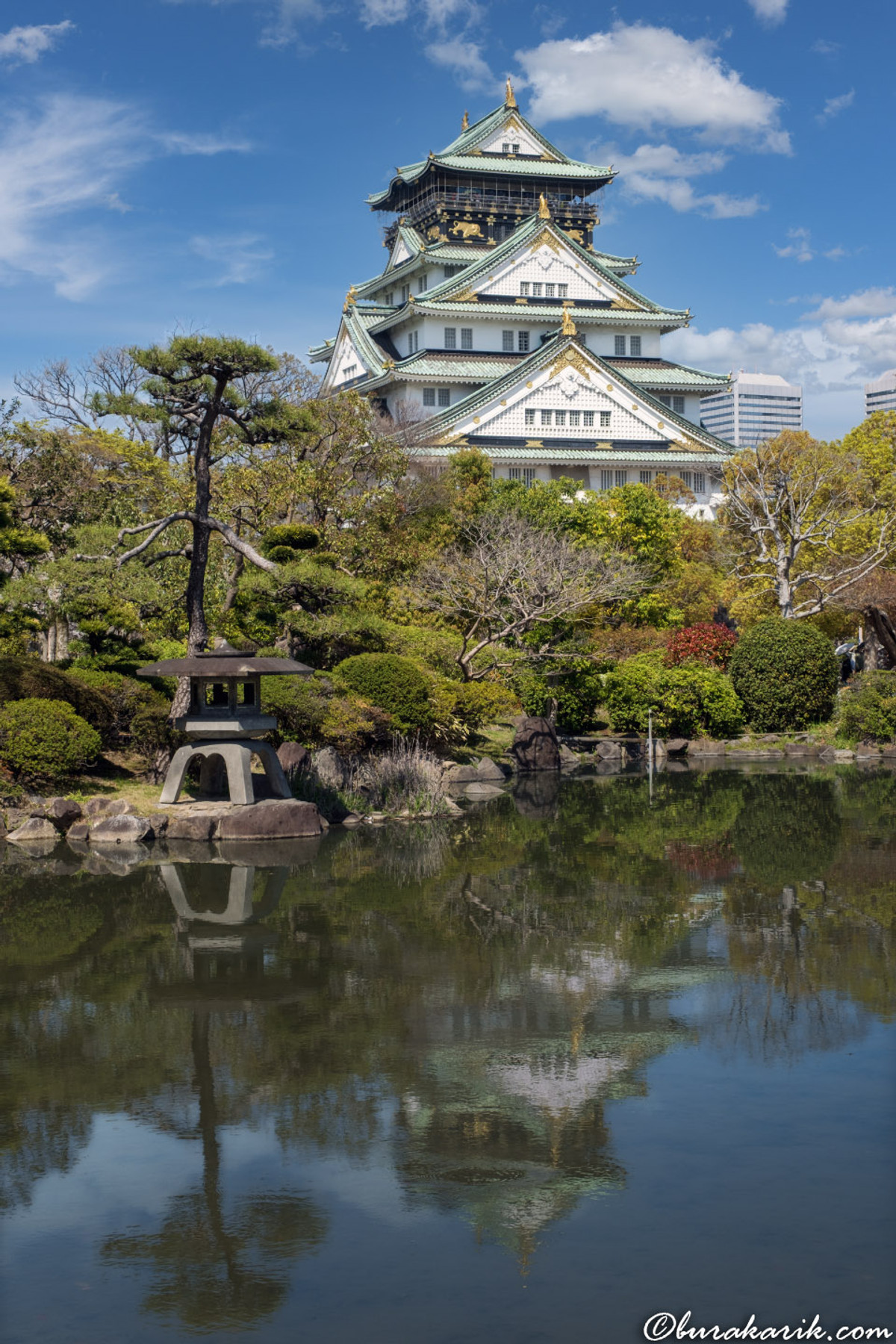 📍 Photo spot: Osaka Castle View →
Osaka Castle from the moat reflection, 34mm, f/8, ISO 125. The castle itself has been reconstructed multiple times and the current structure is 20th-century concrete, which doesn't matter for the photograph — the silhouette is the subject. Walk the full perimeter of the moat; there are four distinct vantages and the east side is usually the least crowded.
Late afternoon we walked through Namba down to Dotonbori and Ebisu Bridge. Dotonbori is the reason you came to Osaka with a camera: a narrow canal, saturated neon signs on both banks, and the Ebisu Bridge vantage that stacks the Glico running-man sign against the canal reflection. Blue hour was roughly 18:15 and I positioned on the Ebisu Bridge fifteen minutes earlier to let the ambient color drop enough for the neons to pop.
The honest reason I didn't shoot Dotonbori at blue hour had nothing to do with a curfew or timing. By the time we reached Ebisu Bridge, the Osaka day was sitting at the tail end of a long itinerary, and the compounding fatigue of weeks of pre-dawn alarms and full walking days had caught up completely. The camera stayed in the backpack. Not a technical miss, not a logistics problem — just a body that had given everything it had and was done for the day. If you're building a similar trip, front-load Osaka.
If you can stay in Osaka overnight, do it. A Kyoto ryokan curfew costs you the full-dark Dotonbori neon window.
Day 9: Shinkansen East — Omoide Yokocho with a Second Pass
4 stops
| Distance walked | Transit + evening wander |
| Photos kept | 0 (all archived, no keepers) |
| Sunrise / Sunset | 05:42 / 18:20 |
| Locations | Kyoto Station, Tokyo Station, Shinjuku, Omoide Yokocho |
Morning walk from Wajimaya to Kyoto Station with all the bags, Nozomi 116 east at 09:30, Car 13 Row 17, arriving Tokyo at 11:45. The Mt. Fuji pass in reverse is on the left-hand side now, and we got about fifteen minutes of visible mountain — a handheld exercise at 1/1000s and anticipation. Fast shutter, eyes up from the 40-minute mark. The window timing is the whole challenge; you don't get to recompose, you just get one pass.
Checking back into Home n Lounge in Shinjuku carried a quiet efficiency that's hard to overstate after nine days on the road. We already knew the apartment, already knew the lockbox, and — more importantly — already knew the transportation grid around it. No reorientation, no lost hour figuring out which exit leads where. That familiarity meant we were out in Omoide Yokocho and Golden Gai within the hour, doing a second pass through both alleys with far more intent than the first. No frames from that evening made the final edit, but the scouting paid off in the Tsukiji morning ahead.
This is the structural lesson of a long trip: the repeat visits are where the good pictures happen. First pass you learn the geometry; second pass you work it. If you can build any repeats into your own itinerary — same alley twice, same pagoda twice, same market twice — the second pass outshoots the first almost without exception.
Day 10: DisneySea from Harbor to Fireworks
| Distance walked | Full-day park |
| Photos kept | 0 (family-documentary day) |
| Sunrise / Sunset | 05:40 / 18:20 |
| Locations | Tokyo DisneySea — Mediterranean Harbor, Fantasy Springs, Mermaid Lagoon, Mysterious Island |
DisneySea is the family-documentary day, not the portfolio day, and I'm including it because if you're traveling with kids, a park day is going to happen and the scheduling matters. Morning Yamanote to Tokyo Station, then the JR Keiyō line to Maihama. Download the Tokyo Disney Resort app before you go; Premier Access for the headline rides is purchased in-app on the day, and without it your Fantasy Springs attempt is a multi-hour queue.
Photography-wise: Mediterranean Harbor at park opening gives the cleanest castle-and-volcano skyline without crowds. Fantasy Springs, which opened in 2024, is the strongest postcard frame in the park, and the afternoon light there is good. The night harbor show with drones and fireworks doubles in the water reflection — stand on the far harbor shore looking back at the hotel side for the best vantage. But this was the last day of a thirteen-day trip, and by this point my back had taken enough. I left the camera backpack at the ryokan entirely and went in with just my kids. No keeper frames, no regret about that.
A theme-park day inside a photography trip is a documentary day, not a portfolio day. Schedule it, accept it, don't expect keepers.
Day 11: Tsukiji's Last Morning — Homeward by Dusk
4 stops
| Distance walked | Tsukiji + Tokyo Station transit |
| Photos kept | 0 (notebook day) |
| Sunrise / Sunset | 05:39 / 18:21 |
| Locations | Tsukiji Outer Market, Tokyo Station, Narita Terminal 1 North Wing |
Last morning. Luggage into Tokyo Station coin lockers the night before meant we ran Tsukiji hands-free, which is the only way to do it. The outer market is closed Sundays and most Wednesdays, so aim for a Monday, Tuesday, Thursday, Friday, or Saturday. We moved through the market in order: tamagoyaki at a casual, no-frills counter where they hand it to you on a stick still warm, then straight to one of the outer market's well-known belt-style sushi chains for a last round of nigiri. A quiet, unhurried send-off before the Narita Express.
The Nijūbashi Bridge detour over the Imperial Palace moat was planned and skipped — the morning ran long and we needed to be back at Tokyo Station for ekiben and the Narita Express. Next trip I'd schedule the early Imperial Palace moat frame before Tsukiji rather than after; the light there is best shortly after sunrise. ZIPAIR operates out of Narita Terminal 1 North Wing, which is not where most international carriers dock — check the terminal before the taxi. Check-in closes one hour before departure; we cleared at 20:30 for a 21:30 flight, which was too close.
And that was the trip. Thirteen days, two cities and change, 33 keeper frames out of something like two thousand captures. What the light gave, it gave early or late; what it took back was mostly the middle hours of the day, which is true of Japan in any season but especially so in sakura week when the crowds compound the light problem.
If I were planning this again, the three changes would be: stay in Osaka overnight rather than day-tripping from Kyoto; add a 70-200 equivalent for the Fushimi Inari gate stack and the Chureito Pagoda compression; and book one more early-morning sortie in Kyoto, probably to Arashiyama's Togetsukyō at first light, because the bamboo-grove-at-dusk decision cost me a dawn option I'd like to have had. The XF16-80mm was the right single lens but it's a two-lens trip when you can carry it.
The gear wish list is short: I missed a graduated ND at Kawaguchiko when the midday sky-to-water dynamic range exceeded a single exposure, and I'd add the XF70-300 or the 50-140 f/2.8 for the telephoto compression frames this trip proved I wanted. Everything else stayed in the bag for a reason. The X-T5 files held up at ISO 3200 in Fushimi, in Arashiyama at dusk, and inside Higashi Hongan-ji without asking for heroic recovery in post.
The return-worthy spots are Fushimi Inari before 7 AM, the Kitasandō approach at Meiji Jingu in filtered morning, Lake Kawaguchiko's east shore at first light, and the Arashiyama bamboo grove ten minutes before sunset. Those are the four frames I'd fly back for. Everything else on this trip was good; those four are repeatable if the light lands.
A last thought on the shape of the journey: the single most useful decision was alternating hard days with breath days. Day 3 at Meiji Jingu, a deliberate sleep-in between Sensō-ji and the Fuji van, is the reason the Fushimi Inari morning actually happened. Plan for rhythm, not for maximum coverage. Japan is a place that rewards patience at 5 AM and punishes ambition at 1 PM.
How many days do I need for a sakura-season Japan photography trip?
When is cherry blossom peak in Tokyo and Kyoto?
Should I do Tokyo first or Kyoto first?
What single lens should I bring for most of Japan?
How do I photograph Fushimi Inari without crowds?
Is a private Mt. Fuji day tour worth it versus training yourself?
How do I book Shibuya Sky and teamLab Planets?
Can I bring a tripod into Tokyo temples and observation decks?
How should I handle the shinkansen Mt. Fuji window?
How do I photograph Yasaka Pagoda and Ninenzaka without crowds?
What weekday should I plan Tsukiji Outer Market for?
How do I handle photographing people in traditional dress respectfully?
What is the biggest mistake photographers make during sakura season in Japan?
Is this Japan sakura itinerary better for photographers or first-time visitors?
Should I prioritize Tokyo or Kyoto for cherry blossom photography?
What should I do during the middle of the day on a photography trip in Japan?
Keep exploring
Travel Guides
Day-by-day photographic guides with maps, gear notes, and the photos shot along the way.
Photo Galleries
1,300+ travel photos from 43 countries, organized by destination with EXIF and GPS.
About the Photographer
Years behind the lens, gear philosophy, and the story behind the portfolio.
Get in Touch
Questions about prints, licensing, or a shoot? Reach out and start a conversation.