
Photographer's Guide to Japan: 13-Day Sakura Itinerary (2026)
infoKey facts
Trip at a glance | |
| Season shot | Late March to early April, sakura peak |
| Total days | 13 days, 11 on the ground |
| Cities | Tokyo, Fujiyoshida, Kyoto, Nara, Osaka |
| Cameras | FUJIFILM X-T5 |
| Lens range used | 10-80mm (APS-C) |
| Best month | Last week of March through first week of April |
| Locations covered | 30+ named spots across 11 shooting days |
Quick answers
Where is the best spot to photograph Mt. Fuji with a pagoda?
How do I photograph Fushimi Inari without crowds?
What lens do I need for most of Japan?
Can I bring a tripod into Tokyo temples and observation decks?
When is cherry blossom peak in Tokyo and Kyoto?
How do I book Shibuya Sky and teamLab Planets?
Is a private Mt. Fuji day tour worth it?
| Gear | Frames |
|---|---|
| Fujifilm XT-5 Mirrorless Camera | 33 |
| Fujinon XF 16-80mm f/4 R OIS WR | 29 |
| Fujinon XF 10-24mm f/4 R OIS | 4 |
The alarm was set for 4:50am on our first full morning in Tokyo, and I remember lying there in the dark of the Shinjuku apartment wondering if dragging a family of four across the Pacific for cherry-blossom week had been a sane decision. Then I pulled the curtain, saw the sky already going indigo, and grabbed the X-T5.
This is a late-March trip: sakura peak in Tokyo, a one-day private run to Mt. Fuji, five nights in a Kyoto ryokan, a Nara day, an Osaka day-trip, a Disney day, and a Tsukiji breakfast on the way to the airport. Eleven shooting days, one Fujifilm body, two zooms doing almost all the work, no tripod most days. The one regret: Osaka deserved more. I spent most of that single day at Osaka Castle and barely grazed Dotonbori. Five days in Kyoto was the right call; a sixth would have been wasted. That extra night belongs in Osaka.
The photographic character of Japan in sakura week is that you are always trading sleep for solitude. Every iconic frame, Fushimi Inari, Yasaka Pagoda, Chureito, Arashiyama bamboo, is empty for exactly one window, usually 5 to 7am, and packed the rest of the day. Build the trip around that window and everything else falls into place.
Light-wise, late March gives you sunrise around 5:35 and sunset around 18:00, stretching to 18:20 by the Kyoto leg. Golden hour is short and blue hour is generous. Haze thickens over Tokyo and the Fuji lakes after 10am, so cones-and-compressions are a morning problem. City neon is an after-dinner problem. Plan accordingly.
The thesis I kept coming back to, by day three: Japan rewards photographers who show up early and stay late. The middle of the day is for walking, eating, and scouting. The pictures live at the edges. You can see the whole guide as a series of those edges, stitched together with shinkansen rides and Yamanote Line transfers.
March 27, Friday — Senso-ji at dawn, teamLab after dark
statsDay stats
| Distance walked | 10.9 km |
| Photos kept | 4 from a much larger take |
| Sunrise / sunset | 05:36 / 17:58 |
| Golden hour | 17:24 to 17:58 |
| Weather | Clear, light haze by mid-afternoon |
We caught the Asakusa Line pre-dawn with the apartment still asleep behind us. Senso-ji at 5:45am belongs to cleaners, a few runners, and the occasional photographer. Kaminarimon's giant red lantern was already lit, Nakamise-dori's shutters were down, and I spent the first hour working the approach without a single tour bus in frame. Then the wedding couple arrived. I walked over, asked permission, they smiled and nodded. I never learned the occasion, but standing under that lantern for a portrait seems to be simply what locals do.
 📍 See this exact spot →
I did not plan for them and I could not have asked for better. A bride in a white kimono, a bouquet of pale blooms, her groom at her shoulder, and the Thunder Gate lantern glowing behind them. I worked the 16-80mm at 27mm and f/4, keeping the couple crisp while the gate read as context, not subject. The architecture stays a stage; the two of them stay the story.
By late morning we were on the Yamanote to Shibuya, and the mood shift from a hushed temple courtyard to the signage chaos of Center Gai is exactly why Tokyo is a photographer's city. I stopped fighting the density and started framing into it, shooting the crowd itself as texture, the way a forest photographer shoots a thicket.
 📍 See this exact spot →
At 30mm and f/7.1 I had enough depth to keep both the foreground pedestrians and the back-wall signage legible. Shibuya does not reward a shallow-depth aesthetic; it rewards layers. Let the katakana, the English, the pachinko pink, and the convenience-store white all sit on the same focal plane. That is the photograph.
Our Shibuya Sky slot was 13:00 to 13:19, booked through Klook a week out because walk-up is basically impossible in sakura week. The 46th-floor rooftop enforces pocketable cameras only, no tripods, no bags, no neck straps. The X-T5 with the 16-80mm attached, carried in hand, passed without comment. Leave the camera bag in the locker on the way up.


I worked two frames from the west edge of the deck. One looked straight down on the Scramble Crossing, the dance of pedestrians reading better as a black-and-white graphic than as color; the other panned across the skyline with Tokyo Tower holding the right third of the frame. At 54mm the Tower reads as a punctuation mark inside the grid, old rising through new, which is the Tokyo photograph you are actually there to make.
Every iconic Japan frame is empty for exactly one 90-minute window. Build your day around the window; everything else is lunch.
The rest of the day went Harajuku, Takeshita Street, back through Shibuya Crossing at blue hour on foot, Yurikamome out to teamLab Planets in Toyosu for an 18:30 slot, and a final walk from the apartment up to the Tokyo Metropolitan Government Building observation deck, which is free and open until 10pm and permits tripods, the best blue-hour-to-night perch in Shinjuku for anyone carrying real glass.
March 28, Saturday — Chureito Pagoda and Mt. Fuji's ideal compression
statsDay stats
| Distance covered | 101 km (private van) |
| Photos kept | 6 |
| Sunrise / sunset | 05:39 / 18:03 |
| Golden hour | 17:29 to 18:03 |
| Weather | Clear AM, clouds building around Fuji by 13:00 |
We booked a private Mt. Fuji tour through GetYourGuide, the customizable Itinerary B, with a 6am pickup from the apartment lobby. An English-speaking driver, a clean van, vehicle and tolls and guide included, meals and the ropeway extra. For a family of four with a kid in the mix, a single-transfer door-to-door day beats any train-and-bus combination I could have stitched together.
Fuji visibility is the whole variable. The mountain makes its own afternoon weather, so clear cones are a before-10am problem. Our driver took us to Kawaguchiko first, against the usual tour-bus clockwise grain, and parked us at the north-shore vantage while the air was still crisp.
 📍 See this exact spot →
I worked the 16-80mm at 21mm and f/7.1, low enough to let the yellow reeds and a patch of early flowers carry the foreground and the snow cone punctuate the frame. The lake was glass. Early-morning Kawaguchiko is the quietest Fuji gets, and shooting wide rather than long is the move here, because the value is context: mountain plus water plus spring floor.
From Kawaguchiko we drove the ~20 minutes to Arakurayama Sengen Park, and this time the whole family came up the 398 steps with me rather than waiting at the base café. The deck was intense: front-row competition is real, and even once you hold a spot, heads and cameras drift into your frame constantly, so you have to stay opportunistic. Getting the pagoda and Fuji to sit evenly side by side rather than just adjacent took more patience than I expected. We'd done the lakeside first thing that morning, which made us later here than ideal. Reverse the order next time; Chureito is the harder shot and deserves the earlier slot.
 📍 See this exact spot →
Chureito's magic is compression, not blossoms. Our visit was a few days before the local sakura opened, which is why you see bare branches behind the pagoda here; the Tokyo cherries had bloomed but Fujiyoshida is higher and later. I shot at 16mm and f/8 to hold the pagoda's red crisp against the peak. Come back in mid-April if you need the pink. The pagoda-and-cone geometry is the real prize, with or without the blossoms.
Oshino Hakkai was our midday decompression, a spring-fed pond village that photographs cleanly on overcast and gets overrun by lunchtime. By the time we were shooting there, Fuji was already ducking behind a cloud ceiling. The lesson, again: mornings for mountains, midday for ground-level detail.


Fujiyoshida's downtown gives you the other Fuji photograph, the urban one, where the cone sits at the end of an ordinary commercial street flanked by streetlamps and power lines. At 56mm the mountain stacks up on the horizon between the buildings, the quiet absurdity of a 3,776-meter volcano anchoring a small-town shopping arcade. No hike, no hero pose; just a crosswalk and patience.
Fuji makes its own afternoon weather. Cones are a before-ten problem. Detail is a midday problem. Know which one you are chasing.
We rolled back into Shinjuku in late afternoon and I grabbed a second wind for Shinjuku Gyoen at 17:12, the sakura canopies at peak, picnic blankets everywhere, a plane crossing overhead to remind you this is still Tokyo. Then, because the legs would not stop, I closed the day with a 18:20 walk through Omoide Yokocho, the post-war yakitori alley behind the station. 21mm, ISO 1250, f/5.6, hand-held into the lantern smoke.
 📍 See this exact spot →
 📍 See this exact spot →
Omoide Yokocho rewards a mid-range wide and a confident ISO. The lanterns are warm, the alley is narrow, and the atmosphere is grill smoke and old beer. I leaned into the color cast rather than correcting it. A cooler white balance would have felt dishonest about the place.
March 29, Sunday — Meiji's forest and Shinjuku's Golden Gai alleys
statsDay stats
| Distance walked | 5.5 km |
| Photos kept | 4 |
| Sunrise / sunset | 05:34 / 18:00 |
| Golden hour | 17:26 to 18:00 |
| Weather | Bright overcast, soft canopy light |
A deliberate sleep-in morning, which after two pre-dawn starts felt decadent. We left the apartment around 9:30 and caught the Yamanote one stop to Harajuku. Before we even reached Meiji Shrine I looked back over the Yamanote tracks and shot the double-train crossing that you see everywhere in Tokyo street photography, two green livery cars passing each other with skyscrapers stacked behind.
 📍 See this exact spot →
This is a frame you cannot plan. You look up from the crosswalk, both trains happen to be there, and you have maybe four seconds. I shot wider than felt necessary to give the city its full stage. The skyline density is the point; the trains are the verbs inside the sentence.
Meiji Shrine's approach is a forest. You come off the Harajuku crush, cross under a torii, and the city volume drops to a hush. The south torii is the headline, but I preferred the Kitasando side approach where fewer cameras compete.
 📍 See this exact spot →
At 18mm and f/6.4 the torii framed the gravel path cleanly, the Yoyogi canopy pulling the eye through. ISO 640 was forced by how dark the forest reads even at 9am, with bright overcast above; the tree cover eats two stops. Shoot wider than you think, meter for the gravel, and let the torii silhouette take care of itself.
Further in, past the main ablution pavilion, the wall of kazaridaru sake barrels is the detail shot everyone photographs and still looks different each time. Each barrel is donated by a brewery and the label art is the whole reason to stop.
 📍 See this exact spot →
I moved long, 74mm at f/4, to flatten the stack into a wall of graphic labels and isolate a row. Going wide here turns it into a snapshot; going long turns it into a textile. The barrels are offerings first and photographs second, so read the room, shoot from the public side of the rope, and do not ask people to move.
Meiji's forest eats two stops under a bright overcast. Meter for the gravel, trust your ISO, and let the torii be a silhouette.
While my family browsed a toy shop in Ginza, I slipped away and ran a quick search on ChatGPT and Perplexity to find a clean sightline to Tokyo Tower. That research led me to this spot in Minato, so hopefully you can skip the AI interrogation and just use this guide. The Lamborghini stopped at the red light was pure coincidence, its color a striking contrast against the tower's red and white. The car behind it? I wish it wasn't there, but you can't always control the frame.
 📍 See this exact spot →
I had the 16-80mm already at 30mm, stopped to 7.1, and framed so the car's color pulled against the tower's red-and-white. If you grew up on Tokyo Drift, this is the exact scene your teenage self imagined. It took thirty seconds to shoot and I could not have arranged it if I tried. Golden Gai and a second Omoide Yokocho pass closed the night, alley exteriors only, because most bar interiors post no-photography signs at the door.
March 30, Monday — Nozomi west, Kyoto lantern light
statsDay stats
| Distance walked | 0.6 km (transit day) |
| Photos kept | 3 |
| Sunrise / sunset | 05:48 / 18:16 |
| Golden hour | 17:43 to 18:16 |
| Weather | Overcast afternoon, soft directional light at dusk |
Nozomi 253, Tokyo to Kyoto, 10:21 to 12:32, Car 14 Row 1. SmartEX app, QR tickets straight to the turnstile. Bento from Tokyo Station's underground. Two hours and eleven minutes of staring at rice paddies and the occasional Fuji sighting from the right-hand window seats, then Kyoto Station's cathedral-glass roof opens up and the mood of the trip changes.
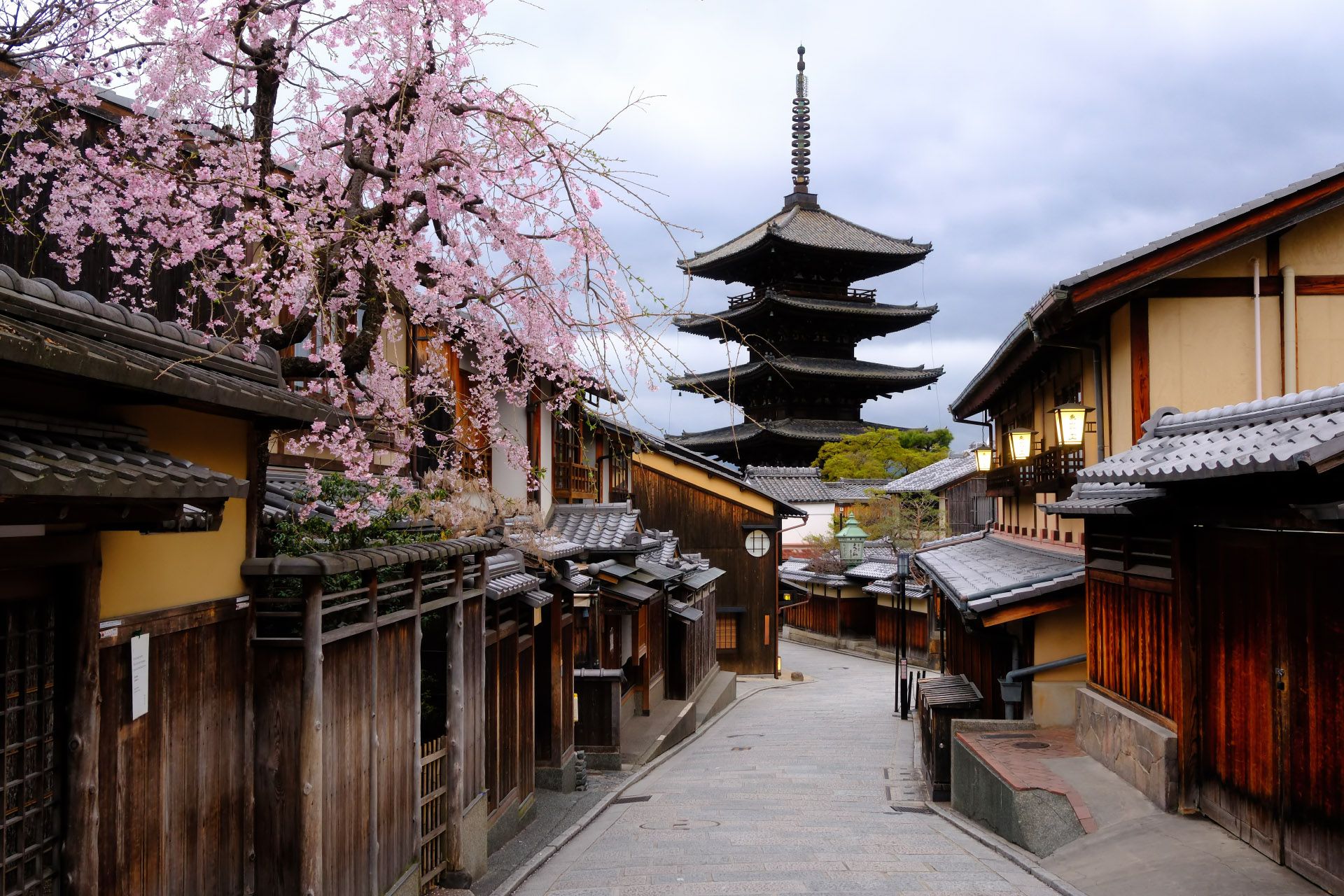
We dropped bags at Wajimaya Ryokan and walked straight into Higashiyama. The afternoon was overcast but even, and I wanted Yasaka Pagoda while the foot traffic was at its most dressed-up, kimono rentals peaking between 1 and 3pm.


The Hokan-ji approach is a narrow slope that funnels everyone into the same axis, the pagoda capping the far end like a stage flat. I worked 46mm and f/7.1 for the wide street scene, kimono color against the dark wooden facades, then 56mm at f/6.4 for a single parasol portrait further back. Both frames are about letting the pagoda exist at the top of the image as compositional ceiling, not subject.
We drifted east toward Kodai-ji as the overcast thickened, and the sakura tree on the temple grounds was doing its best work under the flat sky. I paraphrase it here because the photograph stays in the archive; visually, a raised-ink wash of pale pink against wet-dark temple timber, the kind of scene overcast light was invented for. Kyoto in sakura week is worth overcast. The pinks go truer, the greens deepen, and the reds of temple paint stop clipping.
The Nozomi itself was an event; stepping off it at Kyoto Station, the metropolitan hum just dropped away. Slower city, slower breath, and the overcast sakura light waiting to prove its point.
Dinner was in a Pontocho alley restaurant with existing lantern light only. No flash, no tripod. We rolled back to the ryokan on tatami legs and set the alarm for 4:45am.
March 31, Tuesday — Fushimi Inari's empty torii before sunrise
statsDay stats
| Distance walked | 11.1 km |
| Photos kept | 6 |
| Sunrise / sunset | 05:47 / 18:17 |
| Golden hour | 17:44 to 18:17 |
| Weather | Clear dawn, bright afternoon, soft dusk |
5am at Kyoto Station, two stops on the JR Nara Line, about five minutes to Inari. I went solo. The torii tunnel is workable empty from roughly 5:30 to 7:00 before the first through-trains from Kyoto Station start unloading camera phones at the gate. Miss that window and you are photographing elbows. The kimono walker in this frame never knew she was in it; at 13.8mm the wide field kept her anonymous, a silhouette moving through red rather than a portrait.
 📍 See this exact spot →
I worked the 10-24mm wide zoom almost exclusively here. At 13.8mm and f/8, ISO 400, I could hold the tunnel's depth while a single figure, a woman in traditional dress and parasol, walked through the frame. That figure is not a setup; early mornings in sakura week pull enough kimono walkers for the patient photographer to let one appear. Wait, do not chase.
 📍 See this exact spot →
A few minutes uphill I pushed to 24mm and f/11 to get maximum depth of field on a longer repetition, ISO 3200 forced by the gate shade. About ten thousand gates in total, each donated by an individual or business, carved with the donor's name and year. The rhythm is the photograph. You do not need the whole tunnel, just enough iterations for the eye to understand that it keeps going.
The kitsune fox statues higher up, draped in red offering cloth, hold the story the torii only hint at. Wide lens, low angle, both foxes and the carved kanji stone behind them in one frame. That image stays archive-only for this guide but it is worth knowing the spot exists past the main crowds; climb past the first major fork and the path starts feeling like a shrine again rather than a selfie set.
Family joined at 9am, which meant the corridor shot was already in the bag and I could be a dad for the rest of the day. We took JR Sagano out to Arashiyama, hit the Iwatayama Monkey Park climb (20 minutes, panoramic Kyoto view), and walked Togetsukyo Bridge for golden hour.
 📍 See this exact spot →
Arashiyama Park proper, the stone-path approach before the bamboo grove, was the cherry-blossom surprise of the trip. 19mm, f/6.4, a wash of pink-white hanging over the flagstones. The sakura calendar in Kyoto was peaking exactly this afternoon; we got lucky by about 48 hours.
The bamboo grove itself was the technical puzzle I had been waiting for. It was darker in there than the finished photo suggests; the canopy swallowed the remaining light fast. No railing to brace against, so I leaned entirely on OIS and ISO 3200, trusting the X-T5's high-ISO performance. For a 1.5x crop sensor, it holds up remarkably well. Neat Image in post handled the residual noise cleanly.
 📍 See this exact spot →
ISO 3200, f/4.5, 1/15 second, 46mm. The X-T5's high-ISO latitude earns its keep here; noise is manageable up to 6400 if you meter carefully. I waited for gaps between groups, gave the bamboo the full width of the frame, and let the last real daylight filter top-down through the stalks. Arashiyama bamboo is two photographs, a daytime graphic one and an evening atmospheric one, and the evening one is harder and worth the wait.
The torii tunnel empties for ninety minutes a day. The bamboo grove empties for fifteen. Both belong to whoever showed up first.
We closed the day walking the sakura-lined street back toward the station under the first streetlamps, a tunnel of lit blossoms over an emptying lane. 17mm, f/4.5, ISO 1600. That frame is a softer counterpoint to the bamboo; one is disciplined monochrome green, the other is lantern-warm pink, and both are Arashiyama in April.
 📍 See this exact spot →
April 1, Wednesday — Golden Pavilion and Philosopher's Path in bloom
statsDay stats
| Distance walked | 9.4 km |
| Photos kept | 3 |
| Sunrise / sunset | 05:45 / 18:18 |
| Golden hour | 17:44 to 18:18 |
| Weather | Clear, calm pond water mid-morning |
The day started at Yasaka Pagoda at 5:50am, and the line was already ten people deep. On Ninenzaka, the street slopes upward and then curves left, which cuts off your sightline to the pagoda. The sweet spot is mid-slope: high enough to capture the foreground lanterns, close enough that the curve hasn't stolen the pagoda yet. That morning a woman in a kimono had claimed exactly that spot and was holding it, which sparked a small, very polite quarrel. I waited her out and got exactly one clean frame, nobody in it.


22mm and f/7.1 at ISO 1250, hand-held, for the pagoda frame with a hint of sakura branch bracketing the top corner. Then I walked fifty meters up Ninenzaka itself while the street was still empty and shot at 17.7mm and f/8, ISO 640, with lanterns still glowing down the curve. Ten minutes later both frames would have had crowds; a local photographer next to me nodded and said this is the window.
After a ryokan breakfast we took a city bus out to Kinkaku-ji, which is a one-angle temple. You arrive, you walk to the east-side pond vantage, you wait for the wind to drop so the reflection sharpens, you take your photograph, you leave. The trick is patience for still water; the pond has its own wind lottery and you might wait ten minutes for a clean reflection.
From Kinkaku-ji we bussed over to Ryoan-ji's karesansui rock garden, then back to Teramachi for the KUOE watch shop (closed Tuesdays, which is why I scheduled it Wednesday) and a taxi out to the Philosopher's Path.
Togetsukyo Bridge in the late afternoon gave me a couple in traditional dress, the river behind them, and the kind of diffused light an overcast sky sometimes hands you right at golden hour. That portrait is an archive frame for this guide, but it is worth saying out loud: Kyoto's public spots in sakura week produce more candid human moments per hour than anywhere else I have ever photographed. Show up, stay present, and the frames arrive.
Kinkaku-ji is a one-angle temple. You are not being clever; you are being patient with the wind.
We walked the full Philosopher's Path, about two kilometers at photographer pace along the canal under backlit sakura canopy, and closed at Ginkaku-ji for the moss garden and raised sand cone. If Kinkaku-ji is about the building, Ginkaku-ji is about the grounds, and photographers who rush the moss garden for the pavilion are missing the actual room.
April 2, Thursday — Nara deer, Kiyomizu-dera lit at night
statsDay stats
| Distance covered | 76.8 km (including rail) |
| Photos kept | 5 |
| Sunrise / sunset | 05:44 / 18:19 |
| Golden hour | 17:45 to 18:19 |
| Weather | Overcast morning, clear evening, cold after sunset |
Morning was a second pass at Kinkaku-ji with better light. The first visit had been a scout; this time I knew exactly where to stand and how long to wait for the water to settle.


The wide frame at 29mm, f/7.1, sits the pavilion in its garden context with the reflection holding the bottom third; the tight frame at 80mm and f/7.1 is the gold-leaf close-up, the top two stories in full texture where the leaf catches the light differently with every cloud edge. Two photographs, ten minutes apart, same spot, different stories. The trip's most-used focal length on the 16-80mm was the long end, which surprised me.
This particular deer was actually bowing, which sent my kids into a wave of pure joy. The bowing is real, not a myth. What we missed was the shika-senbei: every cracker stall near us was sold out by the time we arrived, which stung more than expected. If you want to feed them, get there early, the crackers disappear faster than you'd think. The 42.9mm frame at f/8 caught the deer beside the stone lantern just as it dipped its head.


The practical rule is, do not hold the 150-yen shika-senbei crackers in your camera hand. The deer commit. I worked portrait frames at 42.9mm, f/8 with a single deer beside a stone lantern near Kasuga Taisha, and a wider 23.5mm frame of a small herd grazing under sakura in full bloom. Overcast is the cleaner light here; oak canopy produces mottled shadow on deer coats in direct sun, which nobody will edit their way out of.
We took the train back to Kyoto in the late afternoon and walked up through Sannenzaka to Kiyomizu-dera for the spring illumination. The temple lights the grounds and the sakura from dusk on, and the west veranda gives you the whole stage-like terrace glowing out over Kyoto. Tripod territory for anyone shooting this seriously; Kiyomizu's evening opening schedule during sakura season is specific, check it the week of.
Nara's rule is simple: crackers in one hand, camera in the other. The deer commit to whichever hand they can see.
We walked back down through Higashiyama at 20:30 and passed Higashi Hongan-ji lit at night, a green lotus sculpture in the forecourt, one of the largest wooden structures in the world looming behind. Another archive frame, paraphrased here for context. Kyoto at night after a sakura-illumination temple is a city that keeps handing you photographs when you have already put the camera away.
April 3, Friday — Osaka, Dotonbori neon after dark
statsDay stats
| Distance covered | 40.1 km (rail + walking) |
| Photos kept | 3 |
| Sunrise / sunset | 05:43 / 18:19 |
| Golden hour | 17:46 to 18:19 |
| Weather | Clear, warm, excellent blue hour |
Before the train west, I spent the early morning inside Higashi Hongan-ji proper, the vast wooden main hall still hushed before services. Photography is allowed inside, but people were actively praying, so quiet and respect are non-negotiable. Silence every artificial shutter and autofocus sound on your camera before you walk in. The hall earns the attention you give it; do not break someone's moment to get your frame.
 📍 See this exact spot →
The 10-24mm at 12.6mm and f/5, ISO 2500, hand-held, gave me the full sweep of the hall with a few quiet worshippers anchoring the scale. Temple interiors punish timid ISO choices. Shoot wider and higher on sensitivity than you think you need, stay respectful, no flash, and work from the edge of the public area so you are never breaking the composition for anyone praying.
JR Special Rapid from Kyoto to Osaka is about 30 minutes. Osaka is food-led in a way Kyoto is not, and the smart play is to schedule Kuromon Ichiba around appetite and Dotonbori around the blue hour. Midday at Osaka Castle is the middle of that sandwich.
This vantage is a quiet find: it sits at the back side of the castle garden, close enough to the keep that you'd assume it was crowded, but most visitors never loop around. I came here twice; the first visit gave me the reflection frame with the castle in direct light. The second time the pond had fallen into shade while the keep stayed lit, and the imbalance killed the shot. No tripod either, not on a trip averaging 28,000 steps a day with kids in tow.
 📍 See this exact spot →
I shot at 41.1mm and f/8, ISO 125, to compress the sakura foreground against the main keep and keep everything sharp from the nearest petals to the castle's top tier. The mid-afternoon sky was stronger than I expected, which helped the keep's green roof separate from the blue. The reflection frame from earlier in the day lives in the archive; both work, but the sakura version is the one this trip was about.
Osaka is food-led. Schedule Kuromon around appetite. Schedule Dotonbori around blue hour. Everything else is a fifteen-minute metro ride.
Dotonbori for blue hour, the Glico runner from Ebisubashi Bridge, then an hour later for canalside neon reflections. Shinsekai with Tsutenkaku Tower after dinner, a Showa-retro counterweight to Dotonbori's Blade Runner palette. Back on the train to Kyoto on full legs, half asleep by Shin-Osaka.
April 4, Saturday — To-ji pagoda, then east to Tokyo
statsDay stats
| Distance walked | Light, transit day |
| Sunrise / sunset | 05:42 / 18:20 |
| Weather | Clear morning, calm reflection pond |
A 15-minute walk from Wajimaya Ryokan put me at To-ji's southeast pond vantage by 8am, first direct light on the east face of the five-story pagoda, reflection pond virtually empty. This is the closer shot to have in the bag for the Kyoto leg. On a clear morning you can sometimes catch Mt. Fuji from the right-hand side of the later shinkansen; we did not get it this time, but the possibility is there.
Nozomi 116, Kyoto to Tokyo, 9:30 to 11:45, Car 13 Row 17. SmartEX app, same QR-ticket rhythm. We were back at Home n Lounge in Shinjuku by early afternoon and the day was deliberately loose, because the next day was DisneySea and DisneySea is dawn-to-close.
The evening was a second pass through Omoide Yokocho and Golden Gai, no new frames this time, just walking. Sometimes a return visit to a place you already photographed is the most honest thing you can do with a camera, which is to leave it in the bag and notice what you missed the first time.
Return visits are the most honest thing a camera can do: leave it in the bag and notice what you missed.
April 5, Sunday — DisneySea under Mediterranean blue hour
statsDay stats
| Park hours | ~8am open to night show close |
| Passports | 2 adult, 1 junior, 1 child via Tokyo Disney Resort app |
| Sunrise / sunset | 05:40 / 18:20 |
| Weather | Partly cloudy, strong blue hour |
DisneySea is a parenting day dressed as a photography day. We had four 1-Day Passports booked through the Tokyo Disney Resort app, Fantasy Springs Premier Access slots grabbed in-app the moment the day-of window opened, and a plan that went Fantasy Springs at open, Mermaid Lagoon midday, Mediterranean Harbor saved for blue hour, Tower of Terror in the evening, the nightly harbor show as the closer.
No keeper frames worth surfacing in a photographer's guide survived the day, because on a park day with three kids the camera stays mostly in the bag and the phone does the work. What I will say is that DisneySea's Mediterranean Harbor at blue hour is the best-lit theme park space I have ever stood in. If you go, save that plaza for 18:00, not 12:00.
April 6, Monday — Tsukiji breakfast, Nijubashi last light, home
statsDay stats
| Flight | ZIPAIR NRT to SFO, 21:30 departure |
| Last shots | Tsukiji morning, Nijubashi midday |
| Weather | Clear |
Last morning. Tokyo Metro Hibiya Line to Tsukiji-Shijo for the outer market before the stalls break down by noon, then a ten-minute walk to Nijubashi for the iconic stone-bridge-and-palace-gate frame at midday, the Fushimi-yagura guardhouse holding the back of the composition. Tokyo Station's Marunouchi red-brick facade on the way through, Ginza for a lazy lunch, Narita Express by 5pm, check-in at 18:30, wheels up at 21:30.
Tsukiji is a morning-only photograph. By noon the stalls are plywood and the story is over.
Ekiben on the plane, the X-T5 in the overhead bin, eleven days of frames on a single SD card. Across the dateline and home the same afternoon, which is its own kind of photographic dislocation. You land at SFO at 14:45 having left NRT at 21:30 and your body does not know what time it is anymore.
What surprised me, looking back at the take, is how much work the 16-80mm did alone. 29 frames of 33 kept. The 10-24mm earned its four frames at Fushimi Inari and inside Higashi Hongan-ji, and I would not have left it home, but Japan in sakura week is a mid-range zoom's trip. If you are packing one lens, make it a 16-80mm equivalent on APS-C, a 24-120mm on full-frame.
What I would do differently: one more night in Kyoto, one fewer Tokyo district on the back half, and a harder commitment to the 5am window every day rather than two days out of five. The photographs from dawn shifts are always the ones I keep; the photographs from afternoon walks are the ones I like in the moment and delete three weeks later.
Return-worthy spots, in priority order: Fushimi Inari at 5am (obviously), Chureito at sunrise specifically, Arashiyama bamboo at last light, To-ji's reflection pond in calm morning, and Shibuya Sky at a Klook-booked blue-hour slot. That is the five-shot list. Everything else on this trip was bonus frames around those anchors.
Gear wishes: a longer lens for Chureito compressions, something in the 70-200mm range, would let you pull Fuji tighter against the pagoda without standing on the lowest railing. I am adding one to the kit before the next Japan trip. You can browse the full Japan gallery for what the 16-80mm can do on its own, which, as it turns out, is most of it.